





Every week we hear the same opening line from contractors and distributors: “What’s the price of your mobile signal booster ?”
And honestly, it’s the hardest question to answer with a single number — because it’s a bit like asking what a truck costs. A pickup and a 40-tonne trailer both have wheels, but they’re built for different jobs.
Commercial coverage weak signal solution works the same way. The hardware itself is only part of the bill. What really moves the number is the job the system has to do.
So instead of a fake price list, here are the seven factors that decide what a project will actually cost — the same ones we run through when preparing a quote.
First, a rough reality check
Before we dig in, some honest ballparks for commercial-grade work:
- A compact mobile signal repeater kit for a small shop or single floor: hundreds of dollars, hardware only
- A multi-band cellular signal booster system for an office block or factory floor: typically several thousand once antennas, cable and design are included.
- A fiber optic repeater deployment across a tunnel, mining site or long corridor: often tens of thousands, driven mostly by distance and cabling.
These are industry ranges, not quotes. Two projects with the same floor area can land on very different numbers — and the seven factors below explain why.
Factor 1: Which bands and network types you need to cover
This is the single biggest lever.
A single-band booster gsm unit that only lifts 2G voice costs far less than a wideband unit that carries 4G LTE and 5G data at the same time. Most commercial clients now expect calls, video and cloud systems to just work, so multi-band is quickly becoming the default.
The trade-off is real, though: each extra band adds filters, amplifiers and testing inside the unit. A contractor stocking for one region with quiet spectrum can stay lean; a distributor serving several markets usually ends up carrying both single-band and wideband models.
Not sure which bands your market runs on? Our 4G repeater and band selection guide breaks it down by region.
Factor 2: Gain and output power — matched to the area, not maxed out
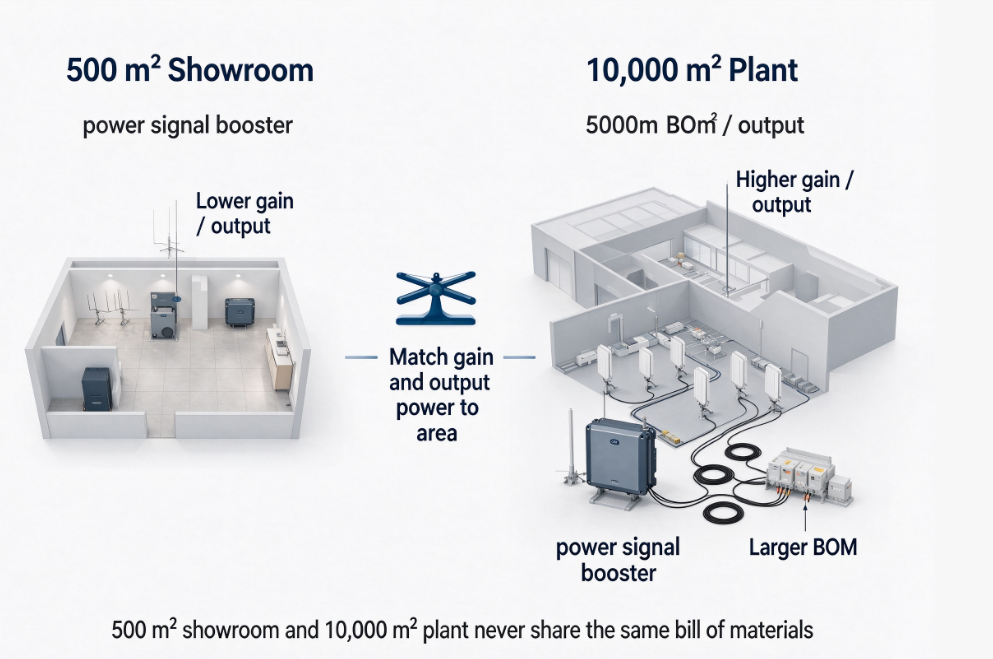
Gain decides how far the amplified signal reaches. More gain covers more ground, but here’s the part people miss: buying more gain than the site needs doesn’t help — and can actually work against you.
Too much output on a small site invites oscillation and feedback into the donor tower, which is exactly the failure that gets an installation ordered off the premises. A properly sized power signal booster with automatic level control beats an oversized one every time.
So price scales with the honest coverage target: a floor, a building, or a whole campus. A 500 m² showroom and a 10,000 m² plant will never share a bill of materials.
Boost Cell Phone Signal In Building
Factor 3: Antennas, splitters and cable — the quiet half of the budget
The repeater box gets all the attention, but the distribution side often matches or exceeds it on a commercial job.
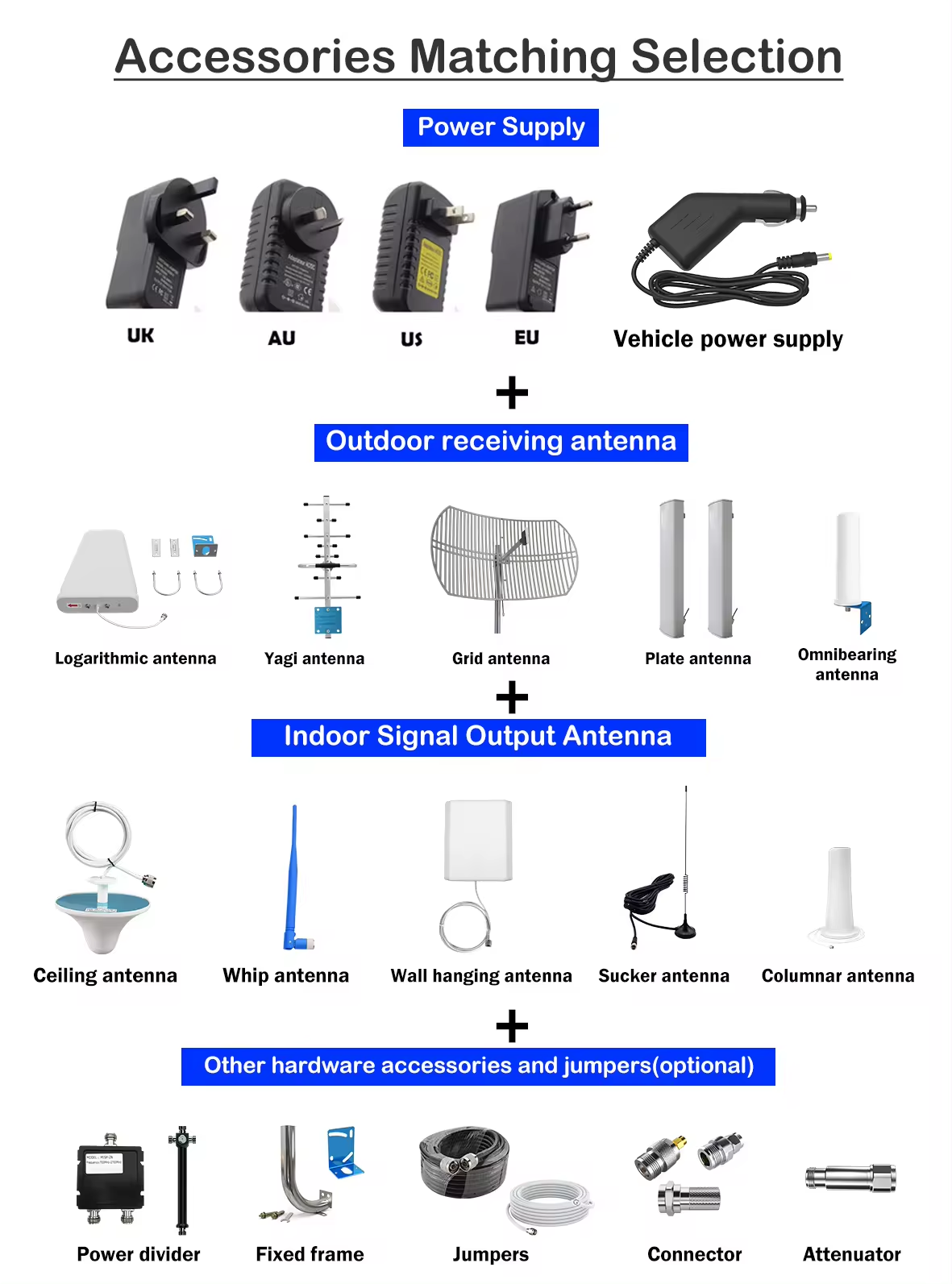
Every additional zone needs service antennas, splitters, connectors and coax runs. Cable length matters too, because signal loss in coax adds up fast over distance — which is why thoughtful antenna placement can save real money on cable alone.
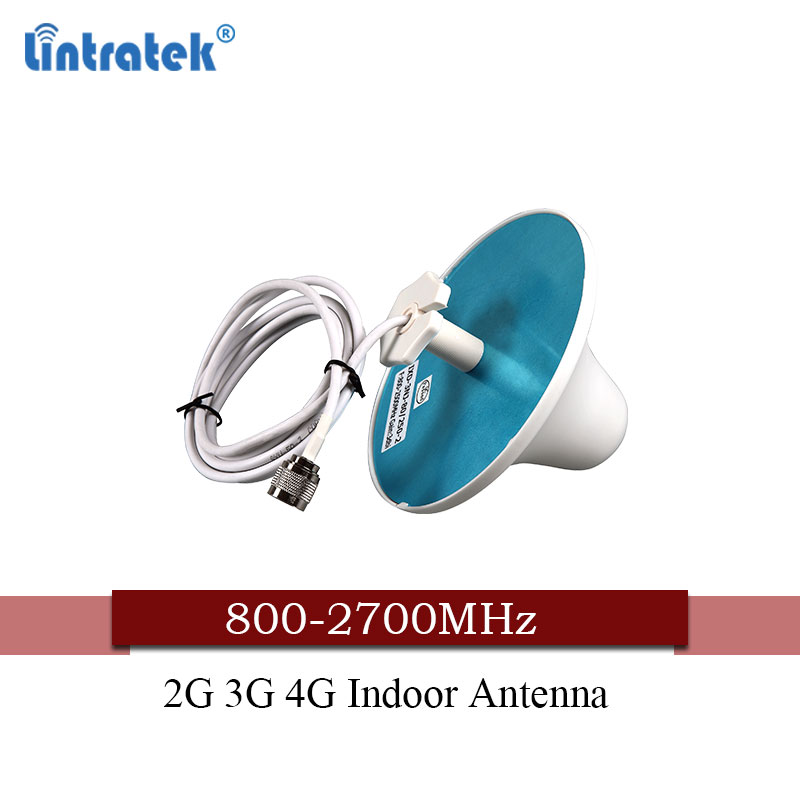
A sensible mobile network booster for office deployments usually spreads four to eight ceiling antennas across floors with a splitter network behind them. The hardware math is straightforward; the labor and routing decisions are where projects win or lose margin.
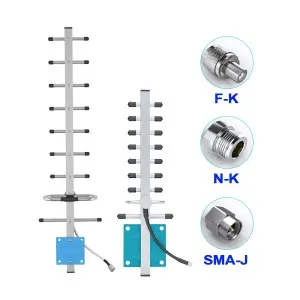
Indoor ceiling mounted antenna Yagi outdoor antenna
Factor 4: How strong the donor signal is at your site
Here’s one that surprises newcomers: the price depends partly on the signal you don’t have.
If a usable donor source sits just over the ridge or down the street, a standard kit handles it. If the outside reading is weak or coming from a difficult direction, the design needs a high-gain donor antenna, careful filtering, and sometimes a taller mast — each line item that didn’t exist on paper yesterday.
This is exactly why a site survey comes before any serious quote. Reading the RSRP at the actual mounting point takes an hour and saves weeks of “we ordered the wrong kit” pain.
Factor 5: Distance — when fiber replaces coax
Coax is affordable up to a point, then it stops making sense. Past roughly a hundred meters of run, cable loss eats most of what you paid for, and fiber takes over.
A fiber optic repeater setup — a master unit at the signal source feeding remote units across the site — costs more upfront, but it’s the only sane route for tunnels, mountain corridors, mining pits and sprawling campuses. Fiber loses a fraction of a dB per kilometer, which is why every long-range mobile network solution we design ends up on this path.
Rule of thumb for planning: short, contained building → RF repeater. Long distance or heavy obstruction → budget for fiber.
Factor 6: Certifications and compliance — cheap to do right, expensive to skip
Certified equipment carries a premium, and some buyers ask us why they shouldn’t just skip it.
Here’s why: in most markets, non-certified boosters are illegal to install, and carriers actively hunt down interference sources. A seized shipment at customs or a forced removal on-site costs far more than the certificate ever did.
Units with CE, FCC or equivalent marks cost a bit more up front. They’re also the only versions a serious distributor can build a business on. When comparing a mobile signal booster price between suppliers, always check what certification is actually included — not just claimed on the listing.
Factor 7: The services wrapped around the hardware
The last factor isn’t hardware at all.
Some suppliers sell boxes. Others provide survey support, system design, installation drawings, commissioning and after-sales help. The second group quotes higher, and for good reason — on remote or complex sites, the design and tuning are where the project actually succeeds or fails.
For contractors and integrators, the question is simply where you want to spend your own hours. If your team handles survey and installation, buy hardware and lean on the factory for design review. If the site is far away or the terrain is ugly, a supplier who stays through commissioning is worth every cent of the difference.

Hidden costs worth adding to your project budget
A quick checklist before you price a job with your client:
- Lightning protection, grounding and weatherproof enclosures for outdoor gear
- Mast, mounting hardware and cable trays
- Permits, where the local authority requires them
- Spare units and connectors — distributors especially, since a dead zone at 9 PM turns into a support call
- Maintenance visits for multi-site rollouts
None of these are dramatic on their own. Together they’re usually 10–20% of project cost, and forgetting them is the classic way a profitable job turns thin.
Quick answers to the questions we hear most
Q1: What’s a realistic mobile signal booster price for a small commercial project?
A1: For a compact kit covering a single small area, expect hardware in the low hundreds of dollars — then add antennas, cable and installation. Anything quoted in double digits is either a consumer gadget or missing something you’ll need.
Q2: Why can two quotes for the same building differ by 3x?
A2: Usually a mix of band count, gain class, cable length and whether one bidder actually surveyed the site. Ask each bidder to show their donor readings and coverage plan — the gap usually explains itself.
Q3: Is it cheaper to buy one big repeater or several small ones?
A3: Almost never one big one. Coverage quality comes from well-placed antennas, not raw power, and oversized single units invite oscillation.
Q4: Can we get OEM units with our own branding?
A4: Yes — that’s a standard arrangement. Our OEM and wholesale program covers custom branding, packaging and documentation for distributor partners.
Post time: Nov-26-2026