





If you run a distribution business for signal equipment, you’ve faced this question at the ordering stage: single-band or multi-band?
It sounds like a technical question, but it’s really a business one. Shelf space, tied-up capital, the customers walking in your door, and the network landscape in your market — all of it hangs on this choice.
Pick wrong, and half your inventory sits in the warehouse gathering dust. Pick right, and every sales conversation gets easier
Let’s walk through what each type actually does, who buys them, and how to split your stock so it sells instead of sleeps.
A thirty-second primer first
A single-band booster gsm unit amplifies one frequency range only — say, 900 、850、1800、2100 MHz alone. Voice calls on that band get stronger; everything else passes through untouched.
A multi-band mobile signal booster unit lifts several ranges at once — typically low-band voice plus mid-band 4G data, sometimes 5G on top. One box, whole network. Between the two sit stepping-stone models like our booster gsm 4g dual-band range, which cover voice and LTE without going full wideband.
That’s the entire technical difference. Everything below flows from it.
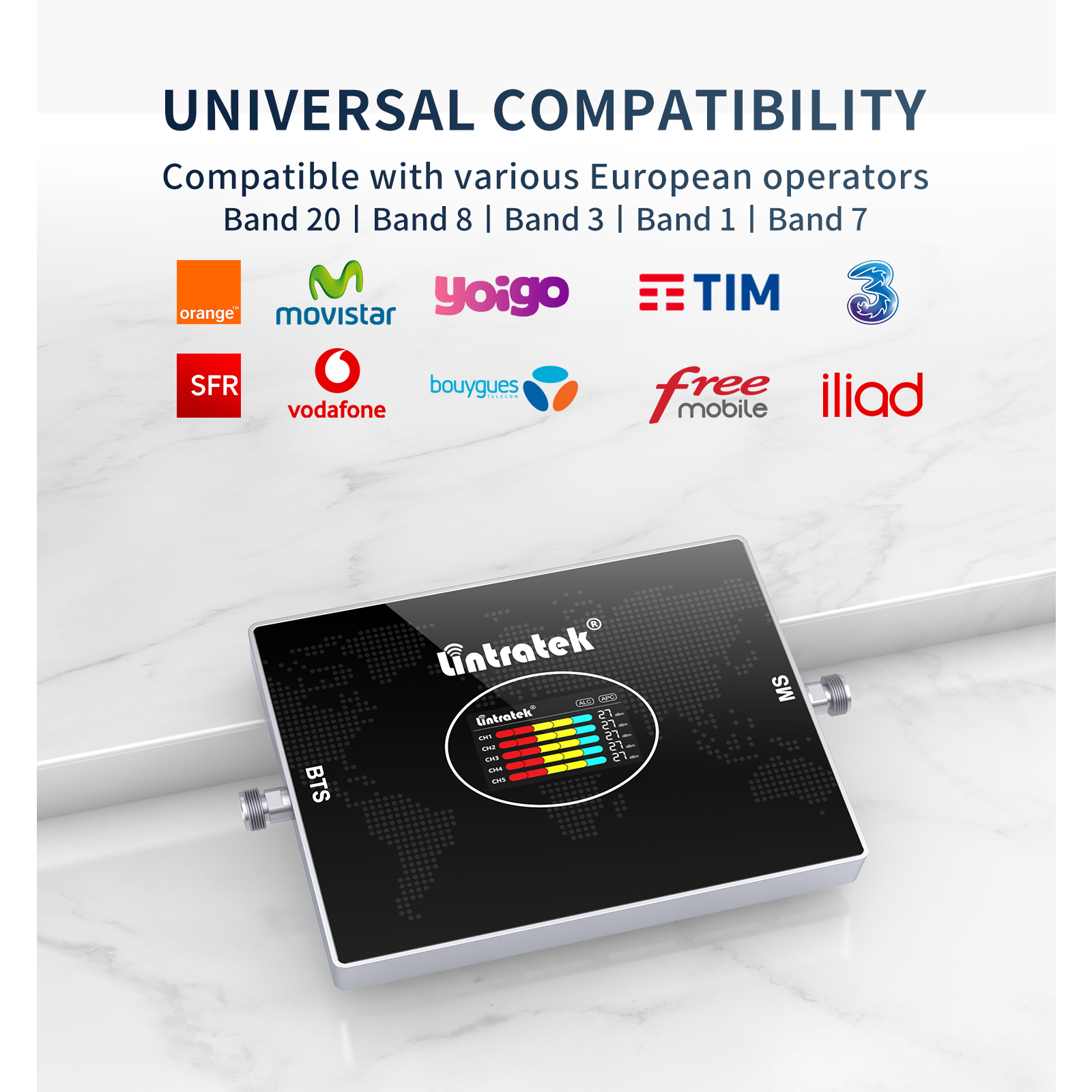
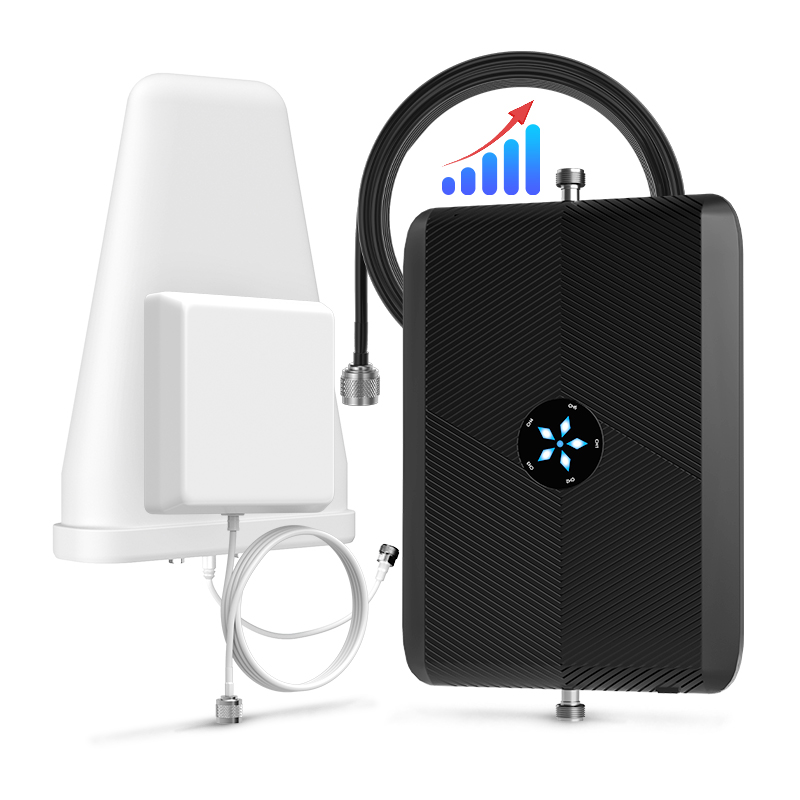
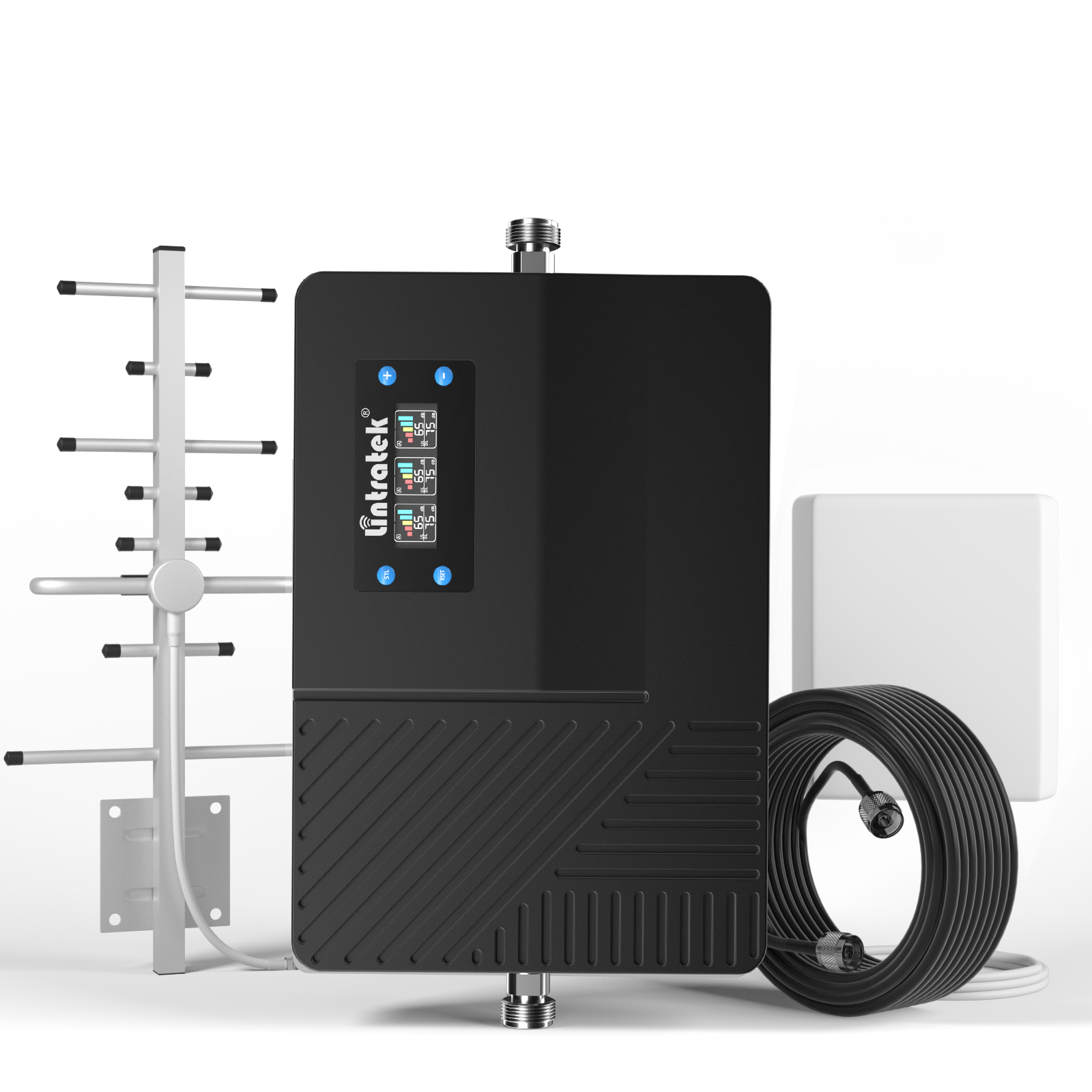
KW20L-five band KW18P- five band KW27A-triple band
Where single-band repeaters still earn their place ?
It’s tempting to treat every single-band repeater gsm unit as the old model on clearance. Don’t — it has three solid markets.
Voice-first regions. In parts of Africa, Central Asia and rural Southeast Asia, 2G GSM voice still does the heavy lifting. Where a customer’s mobile signal coverage means calls, not video, a single-band unit covers the actual need at a friendly price.
Specialist applications. Machine-to-machine links, metering, alarm and SCADA systems often ride on one GSM band by design. Integrators serving industrial clients reach for a dedicated industrial cell phone booster built around exactly that band — and nothing else.
Budget-driven projects. When a contractor’s client just needs calls to stop dropping in a workshop or warehouse, a simple mobile signal repeater closes the sale where a wider system would stall it.
They’re also easier to install and less sensitive to antenna isolation — fewer warranty calls on your desk. For a cell phone booster for rural areas, where power is unstable and the site is remote, simple is a feature, not a compromise.
Where multi-band wins — and it’s a growing list?
The moment a client expects data — video calls, cloud systems, POS terminals, streaming — one band stops being enough.
Commercial buildings are the clearest case. Every office signal booster project has to carry every carrier and every service on every floor. The promise to boost cell phone signal in building fit-outs is now table stakes in leasing meetings, and nobody there says “our tenants only need voice.”
2G and 3G sunsets keep accelerating. Carriers across Europe, Latin America and much of Asia are shutting legacy networks to refarm spectrum. Every shutdown converts a single-band market into a multi-band one, permanently.
Buyers keep moving up the power ladder. A wideband 4g amplifier handles calls and data together; the newest 5g repeater models also future-proof your shelf for the next wave of upgrades. The more capable unit rarely leaves a network behind — which is why it returns less often as a “not what I needed” complaint.
One boundary worth knowing: past a certain building scale, serious buyers move toward in building das solutions instead of standalone repeaters. Keep one referral path open there — losing a bid because you had nothing to offer is worse than passing it to a partner.
The honest trade-offs, side by side
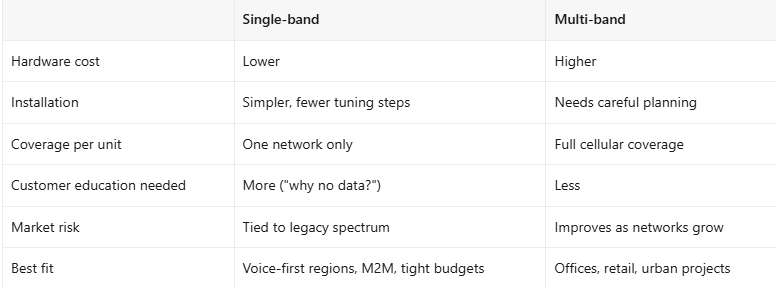
How to read your own market before committing capital
Three quick checks before any purchase order:
1、What do carriers actually broadcast there?
Drive-test or check public coverage maps. If a market still runs strong GSM voice with thin data outside cities, single-band has real room. If LTE is dense and 2G is scheduled to shut, don’t stock what’s being switched off.
2、Who is your buyer?
Integrators doing office and retail fit-outs buy multi-band by default. Agricultural and mining buyers — the people behind most cellular signal booster system projects in remote terrain — often start with voice and add data later, which makes multi-band the safer single purchase.
3、What did last quarter return?
Your own returns and support tickets are the best demand signal you own. Complaints shaped like “the calls work but customers still complain about slow data” are the market telling you to shift the mix.
A stocking mix that works in most markets
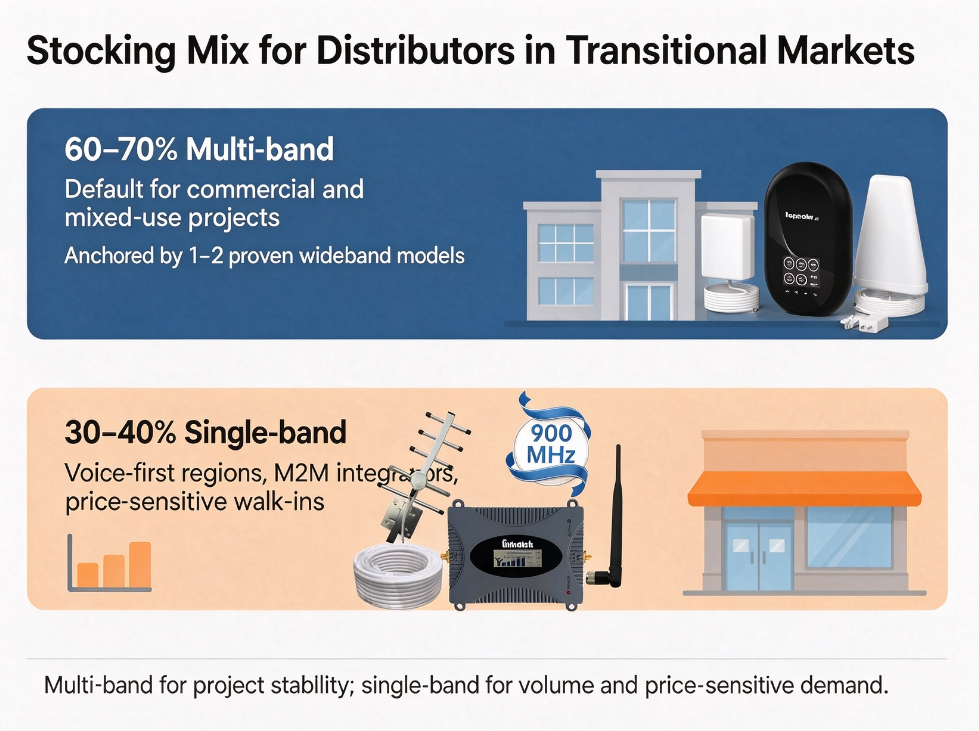
We won’t pretend there’s one formula, but here’s the ratio we see working for distributors in transitional markets:
- Around 60–70% multi-band — your default for a cellular signal system on commercial and mixed-use projects, anchored by one or two proven wideband models.
- Around 30–40% single-band — serving voice-first regions, M2M integrators and price-sensitive walk-ins.
- One demo kit of each — the sale usually closes when the customer sees bars move, not when they read a datasheet.
Markets already dense with cell phone signal coverage can push multi-band toward 90%. Newly opening rural markets can run the reverse. The ratio is a starting point, not a law — adjust it against your sales data every quarter or two.
On pricing: a wideband unit usually carries a better unit margin, but single-band moves faster in volume markets. That’s why a mix beats an all-in bet — one side feeds cash flow, the other feeds profit. When you compare the mobile signal booster price across the Lintratek booster catalogue, check the certification and band table alongside the number — that’s what the price is actually buying.
Quick answers to what distributors ask us
Q1:Is a multi-band repeater harder to install?
A1: A little — more bands means more careful donor antenna placement and isolation. For experienced crews it’s routine; for new teams, start them on single-band jobs first.
Q2: Can I sell a single-band unit as a starter and upsell later?
A2: It works, but set expectations honestly. Tell the customer exactly which parts of their cell phone signal coverage will improve and which won’t. Overselling earns refund requests, not referrals.
Q3: Which sells better online — single-band or multi-band?
A3: Multi-band, consistently. Buyers searching for signal help online usually arrive with a data problem, and listing pages with clear band tables convert better than vague promises.
Q4: What about a huge rural project — voice now, data next year?
A4: Design for the end state, and check the donor distance first. If the site sits far from any tower, a fiber optic repeater may serve the whole valley better than a shelf of small units — we’ll help you price both paths before you commit.
The bottom line for your warehouse
Single-band still has honest work to do — voice-first regions, machine links, tight budgets. But the market’s direction is one-way: carriers keep shutting legacy bands, and data expectations keep climbing.
So stock the mix, not the bet. Let your region’s spectrum reality and your own sales data set the ratio — and when a market starts shifting, shift with it a quarter early rather than a quarter late.
Planning your next order or building a region-specific lineup? Send us your market, your customer profile and the coverage problems your clients complain about most — we’ll help you pick the models and the mix of a mobile network solution that actually moves off the shelf.
Post time: Nov-27-2026